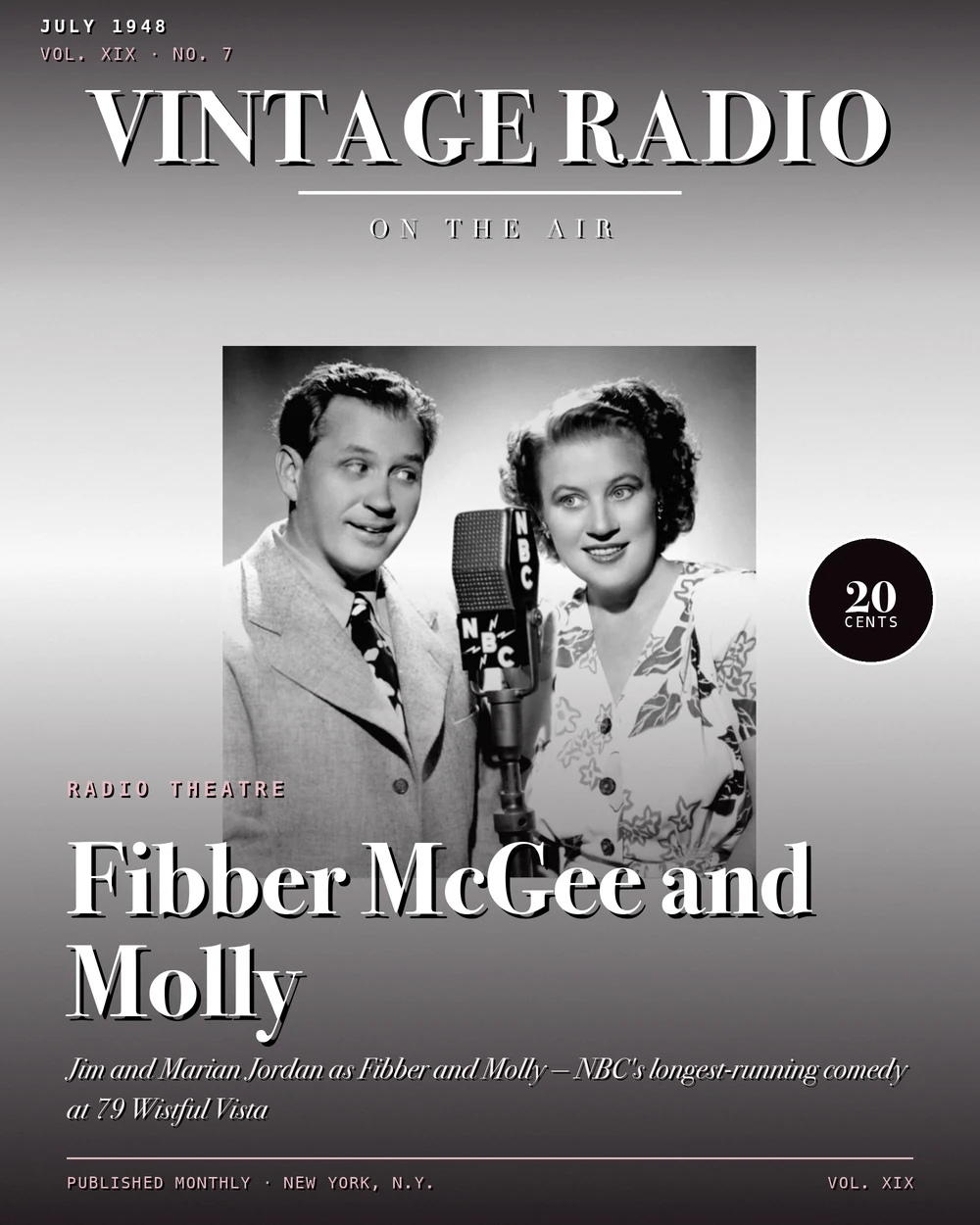
Fibber McGee and Molly
From a $10 Bet to the Top of American Radio
The story of Fibber McGee and Molly starts not in a network studio but in a moment of competitive impulse. Jim Jordan was listening to a singing act on the radio and told his brother Byron he could do better. He bet $10 on it. Jim and his wife Marian rushed to a Chicago radio station, sang "Can't You Hear Me Callin', Caroline?" and "Knee-Deep in the Daisies," performed for about six minutes total, and walked out with their first radio contract — a once-a-week nighttime slot for Oh Henry Candy, paying them $10 a show for six months. That was 1924. By January 1940, Fibber McGee and Molly had a Hooper rating of 30.8, making it the top-rated show in the nation.
That arc — from a $10 bet to the summit of American broadcasting — took about sixteen years of relentless work, a lot of it in places most people never saw. The Jordans spent roughly four years playing small-town movie houses, opera stages, and lodge halls throughout the Midwest before radio took hold. Jim had studied voice after his family moved to Peoria, Illinois; Marian gave piano lessons. They met at choir practice at St. John's Church in Peoria, married on August 31, 1918, and Jim was drafted five days later, arriving in France just in time for the Armistice. Back home, they went broke in Lincoln, Illinois, in 1923. The Jordans were not handed anything.
Jim Jordan was born near Peoria on November 16, 1896. Marian Driscoll was born there on April 15, 1898. Between the mid-1920s and 1935, the two of them built an extraordinary range of vocal characters through a succession of Chicago-area radio programs — The O'Henry Twins on WIBO, Marian and Jim in Songs on WENR, The Air Scouts, Marian and Jim's Grab Bag, Luke and Mirandy, The Smith Family, The Breakfast Club, Saturday Night Jamboree, and eventually Smackout, which opened on WMAQ on March 2, 1931. One researcher, Tom Price, estimated that the Jordans developed enough voice variants during that period to play 145 different parts. Marian alone played 69 separate characters on Smackout. That depth of preparation is what Fibber McGee and Molly eventually ran on.
How the Show Actually Got Built
Smackout was the direct forerunner of Fibber McGee and Molly, and the family resemblance is clear. Jordan played Uncle Luke Gray, who ran a store perpetually "smack out" of everything — a concept drawn from a true story Jordan heard from farm broadcast proprietor E. W. Rusk about a Missouri shopkeeper who used the line as a constant deflection. The store became a gathering place for neighbors and passersby, and the show took on serial qualities. By 1932, one summer storyline ran for more than three months. A 22-chapter arc culminating just before Christmas that year involved the death of Teeny's aunt and Luke adopting the little girl — and Marian's little-girl voice for Teeny, which she had first developed on The Air Scouts children's program as early as 1927, went with her when the whole enterprise moved to Fibber McGee and Molly.
The writer who made the jump too was Don Quinn, an aspiring cartoonist who had turned to radio writing when the Depression killed the comic market. The Jordans had met Quinn in the evenings at WENR, where he began writing gags for them informally for occasional $10 payments. When Johnson's Wax of Racine, Wisconsin — brought to the show by Chicago adman John J. Lewis, who had been steered toward Smackout by his wife — came on as sponsor, Quinn renamed Uncle Luke as Fibber McGee and wrote the pilot. The agency had wanted to call the show Free Air, fitting a premise about married vagabonds on the road promoting Johnson's Car Wax, but that title belonged to a Sinclair Lewis short story and Lewis reportedly wanted $50,000 for its release. The show became Fibber McGee and Molly, and it premiered on the Blue Network on April 16, 1935.
The opening run was on the road — literally. The McGees started the series traveling down U.S. Route 42 in a dilapidated jalopy, with announcer Harlow Wilcox appearing as a gas station attendant who charged 18½ cents a gallon for red gas, 17 cents for blue, and 15 cents for white, and invariably steered every conversation toward Johnson's Car Wax. That vagabond period lasted 19 weeks. On September 2, 1935, Fibber won a house at 79 Wistful Vista by purchasing a raffle ticket, and the show found the domestic setting that would define it for the rest of its run. Arguments about scrubbing the back porch, hanging wallpaper, and lighting the furnace replaced highway sketches, and Marian Jordan later reflected that the "real nature" of the show only emerged once the McGees were settled. She insisted throughout the run that what couldn't happen back home in Peoria shouldn't happen on the show — a grounding principle that kept the comedy rooted in recognizable middle-class life rather than pure absurdist farce.
The Cast of 79 Wistful Vista
The recurring characters who populated Wistful Vista were almost as much a part of the show's identity as the Jordans themselves, and most of them came from one remarkably versatile actor: Bill Thompson, who joined the show in January 1936. Thompson played Greek restaurateur Nick Depopoulous, a W. C. Fields-imitating con man first called Widdicomb Blotto and later Horatio K. Boomer, the Old Timer (whose catchphrase was "That's pretty good, Johnny, but that ain't the way I heerd it!"), and eventually Wallace Wimple — a henpecked husband and bird fancier introduced on April 15, 1941, whose ferocious unseen wife was known only as "Sweetie Face." The word "wimp" as a common English term is generally traced to Fibber's nickname for this character.
Harold Peary arrived as Throckmorton P. Gildersleeve on September 26, 1939, after a period of miscellaneous Gildersleeve-type characters going back to 1938. Peary's Gildersleeve — windy, pompous, forever declaring McGee "a haaaard man" — became popular enough that in August 1941, The Great Gildersleeve became the first major spinoff in radio history, with Peary's character moving to the fictional town of Summerfield to serve as water commissioner. Gale Gordon joined as Mayor LaTrivia on October 14, 1941, and later played Foggy Williams, the weatherman. Arthur Q. Bryan, who voiced Elmer Fudd in Warner Brothers cartoons, first played Doc Gamble on April 6, 1943. Doc and Fibber argued constantly, usually about disputed doctor bills, and usually parted amicably anyway.
Marian Jordan, beyond playing Molly, also played Teeny — the little girl who dropped in to pester McGee with her signature line, "Whatcha doin', huh mister, whatcha?" — as well as dozens of other supporting parts when needed. Isabel Randolph played various high-society types beginning January 13, 1936, eventually settling into the long-running role of the highbrow Mrs. Abigail Uppington. Marlin Hurt, a white man, played Beulah — the McGees' Black cook — in a low falsetto beginning January 25, 1944, with catchphrases "Somebody bawl fo' Beulah?" and "Looove dat man!" Bea Benaderet played Mrs. Millicent Carstairs. Myrt the telephone operator was a recurring presence never heard directly, her character conveyed entirely through Fibber's one-sided phone conversations.
Molly's catchphrases anchored many scenes: "T'aint funny, McGee," "heavenly days!" and the nightly sign-off, "Goodnight, all." Quinn's dialogue famously avoided common oaths; instead of saying "I'll be darned," Fibber would substitute constructions like "Well, I'll be an old Hemingway expression."
The Closet
The closet at 79 Wistful Vista is the single most famous sound gag in old-time radio, and the facts behind it are more specific than the legend suggests. The first use of the closet gag was on March 5, 1940 — Molly went looking in the closet for a dictionary, the door opened, and everything came crashing down. Tom Price's extraordinary 1,193-page statistical abstract, titled Fibber McGee's Closet and self-issued in a limited edition of 100 copies, catalogs 128 closet openings in detail. Fibber opened the door 83 of those 128 times. Price had unusual access to these records: he befriended Jim Jordan in the last decade of Jordan's life and was given the run of Jordan's scrapbooks, script files, and personal interviews.
The physical staging of the gag involved a makeshift set of stairs. The soundmen, according to Price's account, worried throughout the entire run that the rig might come down before its cue. The show also featured a recurring musical tribute to the craftsmen behind moments like that one: Billy Mills composed a piece called "The Sound Effects Man," honoring the people responsible for those crashes, slams, and avalanches, and it was heard periodically on the air. Sound effects through the run were handled by a rotation of specialists including Monty Fraser, Virgil Reimer, Warren Allen, Parker Cornel, Jack Wormser, Cliff Thorsness, Bud Tollefson, and Frank Pittman (who later became a director).
The closet gag became so central to the show's identity that the phrase "Fibber McGee's closet" passed into the American vernacular as a synonym for household clutter. The Museum of Broadcast Communications in Chicago, which holds the bound volumes of Smackout and Fibber scripts donated by Jordan's widow and children after his death in 1988, maintains a dedicated closet exhibit.
The Hard Years and the War Years
In November 1937, Marian Jordan left the show. The public explanation was fatigue. The real reason — kept from the public for 30 years after her death — was that she was battling alcoholism. She was gone for 18 months, returning on April 18, 1939. During her absence, the show was retooled as Fibber McGee and Company, with Betty Winkler handling most female and juvenile roles. The show survived the gap, but Marian's return also brought the full supporting cast into place — Harold Peary, Billy Mills moving with the production from Chicago to Hollywood, and the ensemble that would define the show at its peak.
By the time the United States entered World War II, Fibber McGee and Molly was one of the most listened-to programs in the country, and it leaned into the war effort. The show was described at the time as the most patriotic program on the air with the exception of The Bob Hope Show, featuring homefront themes and regular sign-offs urging listeners to buy war bonds, volunteer, and bring in scrap. In one episode, Fibber bought black market beef — and the show made sure it was portrayed as spoiled. These weren't abstract patriotic gestures; they were written into the weekly domestic comedy the audience already trusted. The show held the number-one rating in 1943 and ran in close competition with Hope, Jack Benny, and Edgar Bergen through the end of the decade. The war also reshuffled the cast: Gale Gordon went into the Coast Guard and Bill Thompson joined the Navy, causing four Thompson characters and Gordon's Mayor LaTrivia to exit simultaneously.
Shirley Mitchell joined on October 5, 1943, playing Alice Darling, a "Rosie the Riveter" character who worked in a war plant and rented the McGees' spare bedroom — a direct reflection of wartime housing pressures worked naturally into the show's domestic frame.
On Screen
Hollywood came calling early. The Jordans took supporting roles in the 1937 Paramount picture This Way, Please, directed by Robert Florey, alongside Charles "Buddy" Rogers and a young Betty Grable. But the real film run came with RKO, and the deal was set up inside the show itself: in the June 17, 1941 episode "Amusement Park," Gale Gordon played an RKO Pictures representative who followed the McGees around the park and offered them a film contract — a piece of in-character marketing that doubled as the real announcement.
Look Who's Laughing followed later in 1941, co-starring Edgar Bergen and Charlie McCarthy, with Harold Peary's Gildersleeve, Arthur Q. Bryan, Bill Thompson, Gale Gordon, and Isabel Randolph all reprising their radio characters on screen. Here We Go Again, directed by Allan Dwan, came in 1942 with the same ensemble; its plot centered on the McGees' 20th wedding anniversary, with Gale Gordon stepping out of the LaTrivia mold to play Molly's ex-boyfriend Otis Cadwalader. The picture returned RKO a profit of $228,000. Heavenly Days, the third and last, arrived in 1944 — directed and co-written by Howard Estabrook, but stripped of the supporting cast that had made the first two work. Only The King's Men vocal quartet came along from the radio company, and the film lost $205,000 at the box office. The McGees made one more film appearance in character, bookending the 1945 war-bond short The All-Star Bond Rally around a stage presentation hosted by Bob Hope; that one lapsed into the public domain in 1973.
The People Who Made It Run
Billy Mills led the orchestra from January 17, 1938, through the final regular broadcast on June 30, 1953 — a span of more than 15 years. He composed the post-1940 theme, "Wing to Wing," and his orchestra featured swing musicians including Red Nichols sitting in. Earlier in the show's life, the vocalist lineup ran through Kathleen Wells, Clark Dennis, Donald Novis, Jimmy Shields, Martha Tilton, and — for thirteen years beginning February 6, 1940 — The King's Men vocal quartet. One name worth noting on that list: a young Perry Como, appearing with the Ted Weems band during the 1936–37 season, years before his solo fame. Harlow Wilcox handled announcing duties from 1935 to 1953, his smooth delivery serving double duty as both show announcer and Johnson's Wax pitchman — Fibber nicknamed him "Waxy" for the constant product praise, and switched it to "Milky" when Pet Milk took over the sponsorship in 1950.
Don Quinn was the primary writer through most of the run, with Phil Leslie joining in March 1943 as Quinn's assistant and eventually succeeding him as head writer. Additional contributions came from Keith Fowler, Ralph Goodman, Tom Koch, Joel Kane, and Leonard L. Levinson. By 1941, Quinn and the Jordans were splitting a $6,000 weekly paycheck three ways. Quinn was notorious for delaying actual script writing until the last possible moment, locking himself in his office with sandwiches, coffee, and cigarettes, then emerging hours later with a verbally dazzling, rarely-revised script. When he finally left the show at the end of the 1949–1950 season, he immediately created The Halls of Ivy, a radio comedy-drama starring Ronald Colman and Benita Hume that premiered on NBC Radio on January 6, 1950, and ran until June 25, 1952. The intersection of 14th and Oak in Wistful Vista, a purely fictional address, was referenced on the show more than 120 times with various made-up businesses and landmarks attached to it. Price cataloged that too.
A pre-broadcast ritual described by Robert M. Yoder in a Saturday Evening Post profile gives a sense of how tightly the live show was run: 11 seconds before airtime, director Frank Pittman pointed at Bill Thompson, who handed Fibber a glass of water; Fibber tossed the plastic glass over his shoulder, it bounced, and the show began on a roar from the audience. Yoder also wrote that the Jordans could "match their vaudeville bruises" with anyone and "played the tank towns" — and that background showed.
How It Ended and What Remained
In 1948, NBC offered to buy the Fibber McGee and Molly franchise outright from Jim Jordan, Marian Jordan, and Don Quinn. The owners agreed, and the show officially became NBC property. The timing mattered: when CBS launched its famous talent raids in 1948–49 and pulled away many of NBC's top comedians, the Jordans stayed put. Quinn departed in 1950 as part of that broader wave, but the show itself remained on its home network. Television, meanwhile, was beginning to bleed Tuesday-night radio dry — Milton Berle's Texaco Star Theatre aired directly opposite Fibber McGee and Molly, and the rest of NBC's Tuesday radio lineup, and the audience figures on that night of the week never fully recovered.
The 30-minute Tuesday night format ran through June 30, 1953. From October 1953 to March 1956, the show shifted to a 15-minute, five-days-a-week format with various sponsors and John Wald as announcer; these episodes were recorded from the Jordans' home in Encino because of Marian's declining health, with music pre-recorded and commercials dropped from the format. From June 1957 to September 6, 1959, reduced vignettes of about four minutes each appeared as segments within NBC's Monitor on Saturdays and Sundays — written by Monitor staffer Tom Koch, structured as five-part weekly serials, and titled Just Molly and Me. Brief appearances in a format that no longer fit the show's original shape.
More than 700 complete episodes survive on tape, preserved by both NBC and Johnson's Wax. A syndicator later stripped music and topical material from circulated versions, judging them dated — a decision that removed some of the texture that made the show what it was.
Marian Jordan died on April 7, 1961. Jim Jordan married Gretchen Stewart and lived in semi-retirement for nearly 30 years before his death on April 1, 1988, at 91. The honors followed: a star on the Hollywood Walk of Fame at 1500 North Vine Street in 1983, and induction into the Radio Hall of Fame in 1989 — the show and the Jordans together at the same ceremony.
What they built deserves the larger claim. Fibber McGee and Molly helped forge the genre later called situation comedy, and it invented the spin-off as a deliberate broadcast strategy: not one but two of its supporting characters — Harold Peary's Gildersleeve in 1941 and Marlin Hurt's Beulah in 1945 — won their own series during the 1940s, with Beulah eventually becoming the first nationally broadcast weekly television series starring an African-American in the leading role. SC Johnson's own corporate history puts the show's peak audience at up to 20 million listeners a week. The Jordans had performed on stage approximately 4,000 times and done approximately 7,000 radio shows by the end. The closet door opened 128 times. The audience always laughed.